


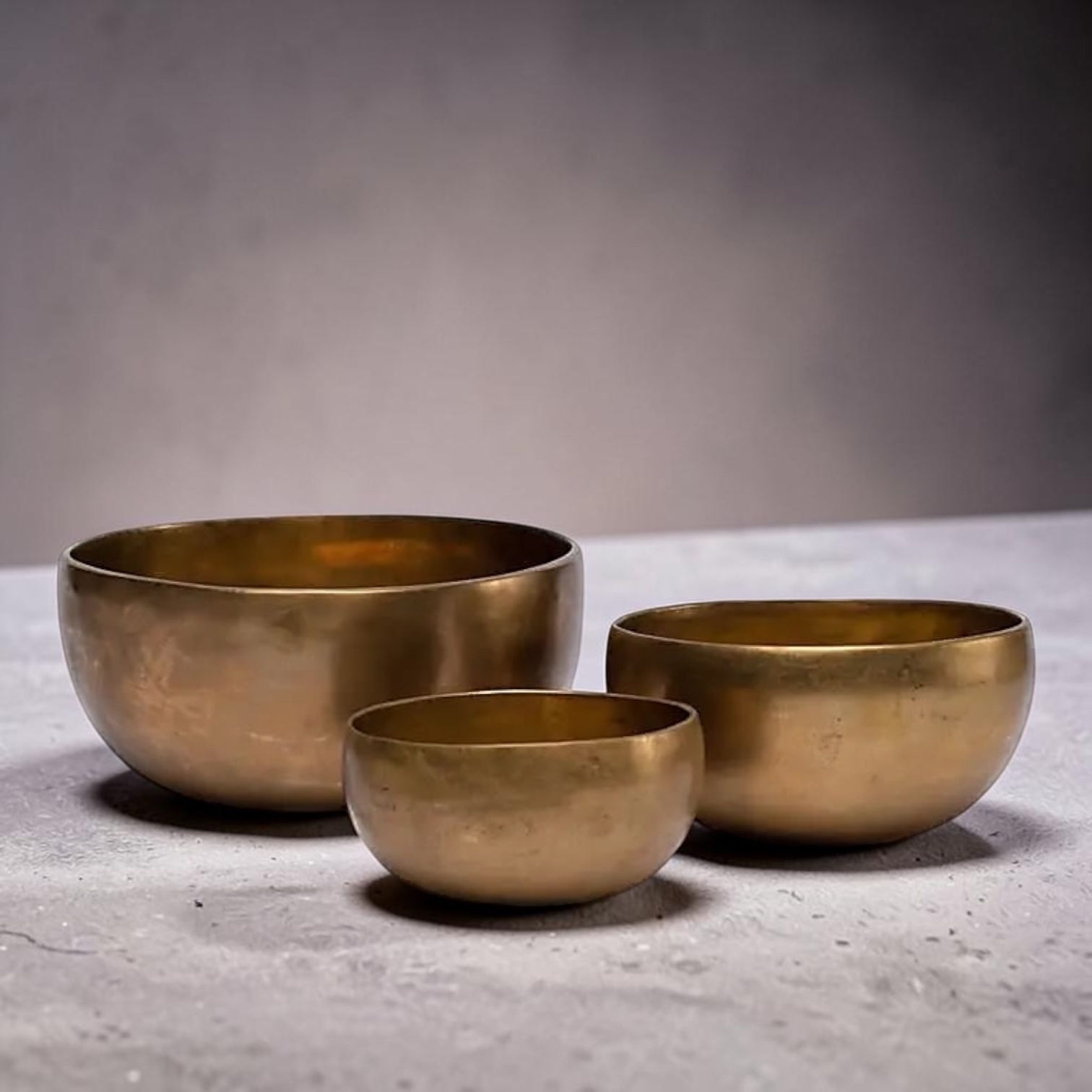

Ohm engraved singing bowls are specialised sound healing instruments, often handcrafted by Nepalese artisans, designed to produce deep, resonant tones that harmonise with the body and mind.
They are deeply connected to the sacred syllable "Om," representing the sound of the universe, the "Big Bang," or the primordial sound of creation.
Meaning and Significance
Universal Sound: The sound of the bowl is considered a "universal tone" (OM) which helps bring the mind into a state of deep meditation, calm, and clarity.
Spiritual Connection: Often associated with Tibetan Buddhism, these bowls are used for chakra balancing, clearing energy blockages, and fostering a connection between the physical and spiritual realms.
"Om Mani Padme Hum": Many Ohm bowls are engraved with this six-syllable mantra, which translates to "the jewel in the lotus," representing compassion and the awakening of consciousness.
Symbol of Harmony: They symbolise peace and balance, often used to cleanse spaces of negative energy.
Sound and Vibration
Resonant Tones: When played with a mallet, the bowl produces a sustained, vibrating "singing" sound that can be heard and physically felt, often described as a "gentle massage" for the body.
Complex Harmonics: Ohm singing bowls typically produce a fundamental, low tone, along with mid-tones and higher "female" overtones.
Brainwave Entrainment: The soothing sound waves are known to guide the brain into alpha and theta states, inducing deep relaxation and reducing stress.
Vibrational Healing: The vibrations can slow down the heart rate and harmonise cells, allowing the body to move from a state of tension (sympathetic) to rest (parasympathetic).
Size Matters: Larger bowls typically produce deeper, more grounding, and longer-lasting tones, while smaller bowls create higher-pitched, clearer sounds.
In essence, an Ohm singing bowl is not just an instrument but a tool for mindfulness and a "bridge between worlds," designed to help individuals return to a state of internal balance.
Ohm' is considered the primordial sound or the sound of creation in various spiritual traditions, including Hinduism and Buddhism. - It is believed to be the sound that resonated at the beginning of the universe and is said to be the essence of all sounds in existence.
Handmade singing bowl made of copper, tin and 8 noble metals (Ag, Ni, Cd, Ru, Pd, Pt, Cr, Mn).
Beaten Singing Bowls Beaten or hand hammered singing bowls are made by way of a complete hand hammering process. Every single singing bowl is carefully hand beaten, which requires several processes to finish up and shape it into a perfect hand hammered singing bowl. In the making process, first the various composition of metals as raw materials (copper, tin, zinc, iron, lead, gold and silver) are melted in furnace, depending on manufacturing needs such as for the making of bronze singing bowls or for seven metal singing bowls. The hot melted metal is removed from the furnace and poured into dice to prepare a metal mould for the various sizes and weights. Then, the round metal moulds are cut into round metal discs in required size and thickness. After that, these discs are hand beaten or hammered, after precise measurement and categorised for weight and sized bowls. Regarding the hand hammering process of singing bowls, 4 to 5 metal discs are piled up, one upon the other, and then heated to red hot. The red-hot metal sheets are hammered by a group of expert artisans, as long as the heat remains in the metal, and then again processed to red hot heating, for a continuous beating process.
This heating and beating of the bundled and piled up metal discs continues until a desired shape and size is formed. (That is why the hammered or beaten singing bowls will be proportionately different in a size and diameter with each individual singing bowl.) During the hammering process of these singing bowls, the metal disc can only be hammered during the time of being red hot, while it remains soft and flexible. Because when the metal gets colder, it will lose its softness and flexibility, which in turn makes the metal brittle and thus the bowl could be ruined. The reason behind this intensive working process is that the metal content (bronze or seven metals mixture) is very sensitive to heat and gets harder when it loses its hot temperature and will get cracks and breaks.
After completion of shaping the desired bowls, the individual work will start. At this stage, every bowl is brought into uniform shape and size, and once more, this can only be done during the red-hot burning and heating and beating process. After finalising the shape and size, more hammering is done for a final fine tuning and shaping of the singing bowls. The individual singing bowls are then chiselled and scoured for the finishing touch, on both the inside and outside.
Size cm ± 9 - 10cm
Total weight 275 grams
Country of origin India


